
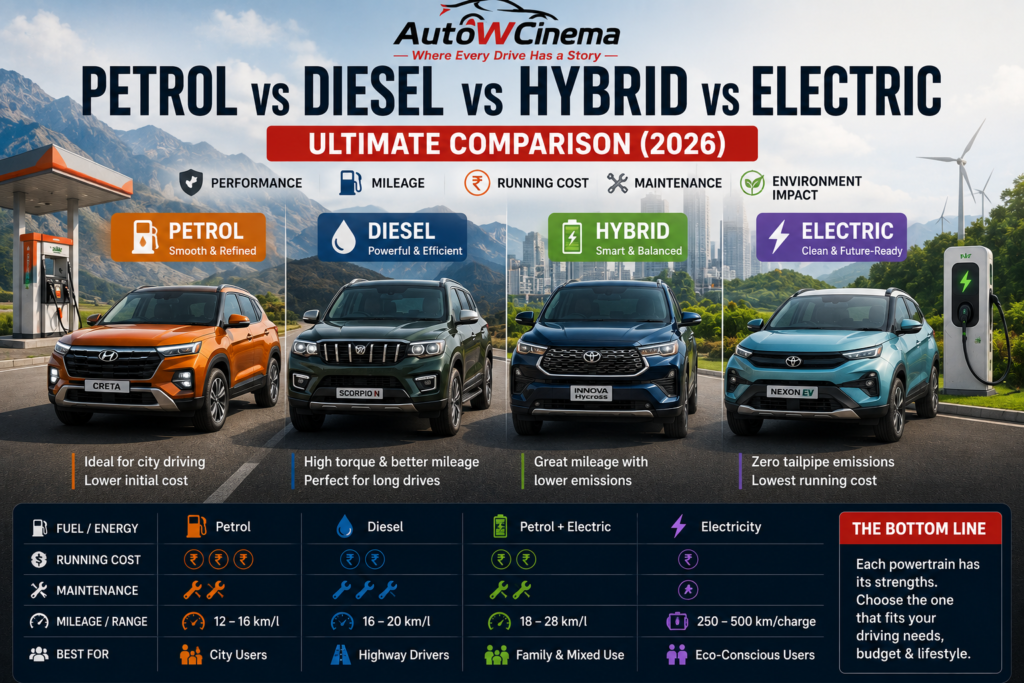
Petrol vs Diesel vs Hybrid vs Electric Cars: Ultimate Comparison (2026) – Which One Should You Buy?
Petrol vs Diesel vs Hybrid vs Electric Cars: Ultimate Comparison
Buying a new car today is more complicated than ever before. A decade ago, buyers mainly had to choose between petrol and diesel. Today, the market offers petrol, diesel, hybrid, and electric vehicles (EVs), each with its own strengths and compromises.
The right choice depends on your driving habits, annual mileage, budget, fuel availability, charging infrastructure, and long-term ownership goals.
In this comprehensive guide, AutoWCinema – Where Every Drive Has a Story compares all four powertrains to help you make the right decision.
Understanding the Four Powertrains
Petrol Cars
Petrol vehicles use spark-ignition engines and remain the most common choice for private buyers in India.
Best For
- City driving
- Low annual mileage
- First-time buyers
Popular Examples
- Maruti Suzuki Swift
- Hyundai i20
- Tata Altroz
- Hyundai Creta Petrol
- Kia Seltos Petrol
Diesel Cars
Diesel engines produce higher torque, making them ideal for long-distance travel and highway driving.
Best For
- Frequent highway users
- High annual mileage
- Heavy SUVs
Popular Examples
- Mahindra Scorpio N
- Mahindra XUV700 Diesel
- Toyota Fortuner
- Hyundai Alcazar Diesel
Hybrid Cars
Hybrid vehicles combine a petrol engine with an electric motor to improve fuel efficiency and reduce emissions.
Best For
- Mixed city and highway driving
- Buyers wanting excellent mileage without charging
Popular Examples
- Toyota Hyryder Hybrid
- Maruti Grand Vitara Hybrid
- Honda City e:HEV
- Toyota Innova HyCross Hybrid
Electric Vehicles (EVs)
Electric cars run entirely on battery power without using petrol or diesel.
Best For
- Urban commuters
- Daily office travel
- Environment-conscious buyers
Popular Examples
- Tata Nexon EV
- Tata Curvv EV
- MG Windsor EV
- Mahindra BE 6
- Mahindra XEV 9e
Comparison Table
| Feature | Petrol | Diesel | Hybrid | Electric |
|---|---|---|---|---|
| Purchase Price | Moderate | Higher | Higher | Highest (generally) |
| Running Cost | Moderate | Lower | Very Low | Lowest |
| Maintenance | Low | Moderate | Moderate | Low |
| Highway Performance | Good | Excellent | Excellent | Very Good |
| City Driving | Excellent | Good | Excellent | Excellent |
| Noise | Quiet | Louder | Very Quiet | Silent |
| Refueling Time | 5 Minutes | 5 Minutes | 5 Minutes | Charging Required |
| Tailpipe Emissions | Higher | Higher NOx/PM | Lower | Zero Tailpipe Emissions |
Purchase Price
Petrol
Usually the most affordable option.
Ideal for budget-conscious buyers.
Diesel
Diesel variants often cost more than equivalent petrol models.
Hybrid
Hybrids typically have a higher upfront cost due to the additional electric motor and battery system.
Electric
EVs generally have higher purchase prices, although government incentives or manufacturer offers may reduce the effective cost in some cases.
Winner: Petrol
Running Cost
Running cost includes fuel or charging expenses.
Petrol
Moderate running costs.
Diesel
Generally offers better fuel economy than petrol, especially over long distances.
Hybrid
Excellent efficiency because the electric motor assists the petrol engine.
Electric
Usually the lowest energy cost per kilometer when charged economically.
Winner: Electric
Maintenance Cost
Petrol
Simple engine design and relatively affordable servicing.
Diesel
Maintenance may be higher due to additional components such as turbochargers and emission-control systems.
Hybrid
Requires maintenance for both the petrol engine and hybrid system, though reliability has improved significantly.
Electric
Fewer moving parts mean fewer routine maintenance requirements.
Winner: Electric
Performance
Petrol
Smooth and responsive, especially at higher engine speeds.
Diesel
Strong torque makes diesel ideal for highway overtaking and towing.
Hybrid
Delivers smooth acceleration with the support of the electric motor.
Electric
Instant torque provides quick acceleration from a standstill.
Winner: Electric
Fuel Efficiency
Approximate real-world efficiency varies depending on driving conditions and vehicle.
Petrol
Typically good for moderate usage.
Diesel
Generally more fuel-efficient than petrol.
Hybrid
Among the most fuel-efficient options without external charging.
Electric
Consumes electricity instead of fuel and is highly energy efficient.
Winner: Hybrid and Electric
Long Highway Trips
Petrol
Comfortable but may require more frequent refueling depending on consumption.
Diesel
Excellent for covering long distances.
Hybrid
Performs well on both highways and city roads.
Electric
Modern EVs can handle long journeys, but route planning around charging infrastructure remains important.
Winner: Diesel
City Driving
Frequent stop-and-go traffic favors:
- Hybrid systems
- Electric vehicles
Regenerative braking helps improve efficiency.
Winner: Electric
Environmental Impact
Petrol
Produces carbon dioxide and other emissions.
Diesel
Produces lower CO₂ per kilometer in some cases but higher nitrogen oxides and particulate matter.
Hybrid
Lower emissions than conventional petrol vehicles.
Electric
Zero tailpipe emissions during driving, though overall environmental impact also depends on electricity generation sources.
Winner: Electric
Refueling and Charging
Petrol
Widely available fuel stations.
Diesel
Equally convenient across India.
Hybrid
No charging required.
Refuel like a normal petrol car.
Electric
Requires charging through home chargers or public charging stations.
Charging times vary based on the charger type and vehicle.
Winner: Petrol, Diesel, Hybrid
Resale Value
Several factors influence resale value, including demand, condition, and service history.
Generally:
- Petrol vehicles enjoy broad market demand.
- Diesel resale remains strong for certain SUVs and high-mileage users.
- Hybrids are gaining popularity.
- EV resale continues to evolve as battery technology advances.
Reliability
Petrol
Proven technology with widespread service support.
Diesel
Reliable when maintained properly.
Hybrid
Many modern hybrid systems have demonstrated excellent long-term reliability.
Electric
Fewer moving parts reduce routine mechanical wear, though battery health remains an important consideration.
Which One is Best for You?
Buy a Petrol Car If:
✅ You drive less than 12,000 km annually
✅ Mostly city driving
✅ Lower purchase budget
✅ Want affordable maintenance
Buy a Diesel Car If:
✅ You drive over 20,000 km annually
✅ Frequently travel on highways
✅ Need strong torque
✅ Own a large SUV
Buy a Hybrid Car If:
✅ You want excellent mileage
✅ Drive in both city and highway conditions
✅ Don’t want to depend on charging infrastructure
✅ Prefer lower emissions
Buy an Electric Car If:
✅ Daily commuting is predictable
✅ You can charge at home or work
✅ You want very low running costs
✅ You prefer environmentally friendly mobility
Advantages and Disadvantages
Petrol
Pros
- Lower purchase price
- Quiet engine
- Lower servicing costs
- Easy availability
Cons
- Lower fuel efficiency than diesel or hybrid
- Higher running costs for frequent drivers
Diesel
Pros
- Excellent mileage
- High torque
- Great for highways
Cons
- Higher maintenance
- Higher purchase cost
- Increasing emission regulations
Hybrid
Pros
- Excellent fuel economy
- Smooth driving
- No charging required
- Lower emissions
Cons
- Higher initial price
- Limited model choices
Electric
Pros
- Lowest running cost
- Instant acceleration
- Silent operation
- Zero tailpipe emissions
- Low routine maintenance
Cons
- Charging time
- Charging infrastructure may vary by location
- Higher purchase price
Future of Cars in India
The Indian automotive industry is rapidly evolving.
Key trends include:
- Growing EV charging infrastructure
- Improved battery technology
- Expansion of hybrid offerings
- Cleaner petrol and diesel engines
- Government support for cleaner mobility
- Increased adoption of connected and ADAS-equipped vehicles
Over the coming years, buyers are expected to have more choices than ever before.
Expert Opinion from AutoWCinema
There is no universal “best” powertrain.
Each serves a different type of driver.
- Petrol remains ideal for most urban users with moderate annual mileage.
- Diesel continues to excel for frequent highway travel and large SUVs.
- Hybrid is an excellent compromise between efficiency and convenience.
- Electric represents the future of urban mobility, especially for buyers with reliable charging access.
Choose the option that aligns with your driving habits, ownership costs, and long-term needs rather than following trends alone.
Frequently Asked Questions (FAQs)
Which is cheaper to maintain: Petrol or Diesel?
Petrol cars generally have lower routine maintenance costs than diesel vehicles.
Are hybrid cars worth buying?
Yes. Hybrid cars offer excellent fuel efficiency, lower emissions, and eliminate the need for external charging.
Is an electric car suitable for long trips?
Yes, but planning charging stops is important, especially in areas with limited charging infrastructure.
Which fuel type has the lowest running cost?
Electric vehicles generally have the lowest running costs, followed by hybrids.
Which fuel type is best for Indian buyers?
The answer depends on your budget, annual mileage, and driving pattern. Petrol suits most city drivers, diesel benefits heavy highway users, hybrids offer balanced efficiency, and EVs are ideal for predictable daily commutes with charging access.
Final Thoughts
Choosing between a petrol, diesel, hybrid, or electric car isn’t about finding a single winner—it’s about selecting the option that best fits your lifestyle.
Evaluate your annual mileage, daily commute, access to charging, maintenance expectations, and long-term ownership costs before making a decision.
As automotive technology continues to advance, buyers have more options than ever to match their priorities, whether that’s fuel efficiency, performance, sustainability, or convenience.
At AutoWCinema – Where Every Drive Has a Story, our mission is to help you make informed automotive decisions. We hope this comparison gives you the clarity to choose the right vehicle for your next journey.
Read to Know Extra :-
- Complete Guide to Buying a Car in India
- Complete Guide to Car Insurance in India
- How to Maintain Your Car
- Understanding ADAS: Levels, Features & Future
- Understanding Bharat NCAP Safety Ratings
- Best Family SUVs in India
- Best Electric Cars in India
- Complete Guide to Car Loans in India
thanks a lot…
Author- Nitesh Kumar