
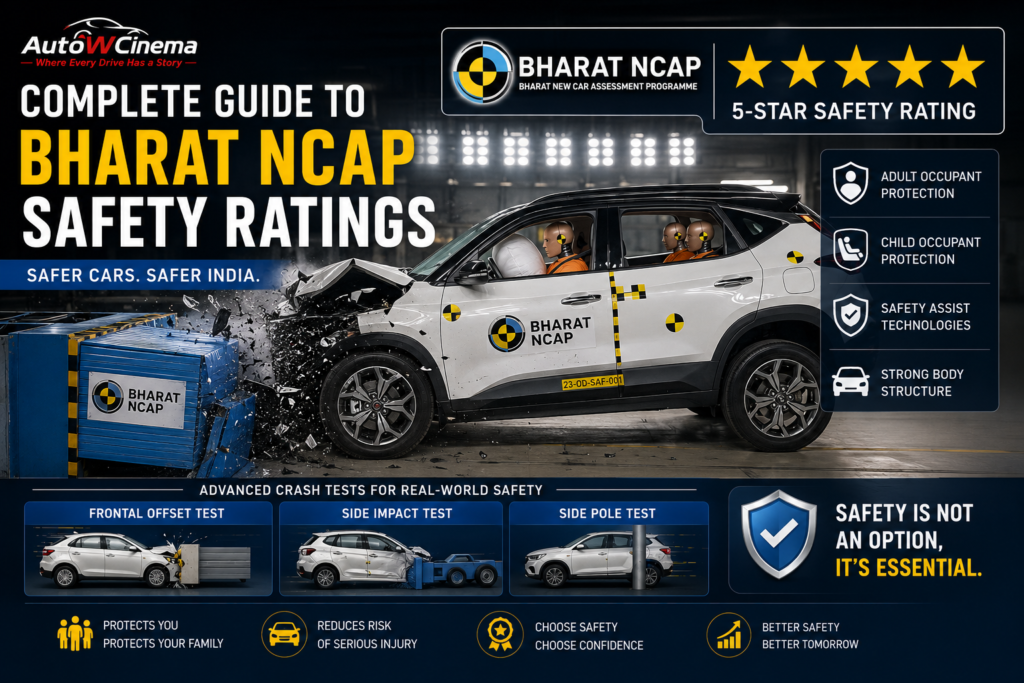
Complete Guide to Bharat NCAP Safety Ratings-Everything Every Car Buyer Should Know…
When buying a new car, most people compare price, mileage, features, and performance. However, one factor that should never be overlooked is safety. A car with excellent safety performance can significantly reduce the risk of serious injuries during a collision.
To help Indian buyers make informed decisions, the Government of India introduced the Bharat New Car Assessment Programme (Bharat NCAP)—a standardized crash-testing and vehicle safety rating system.
In this guide, AutoWCinema – Where Every Drive Has a Story explains everything you need to know about Bharat NCAP, how the ratings work, why they matter, and how they can help you choose a safer vehicle.
What is Bharat NCAP?
Bharat NCAP (New Car Assessment Programme) is India’s official voluntary vehicle safety assessment program for passenger vehicles.
It evaluates how well a vehicle protects its occupants during different crash scenarios and assigns a star rating based on its performance.
The main objective is to:
- Improve road safety
- Encourage manufacturers to build safer vehicles
- Help buyers compare vehicle safety
- Promote advanced safety technologies
Why Bharat NCAP Matters
India has one of the largest automobile markets in the world, and road safety has become increasingly important.
Bharat NCAP helps consumers:
- Compare safety levels easily
- Make informed buying decisions
- Reward manufacturers that prioritize safety
- Increase awareness of crash protection
Instead of relying only on marketing claims, buyers can refer to standardized crash test results.
Which Vehicles Are Tested?
Bharat NCAP currently applies to eligible M1 category passenger vehicles, including many:
- Hatchbacks
- Sedans
- Compact SUVs
- Mid-size SUVs
- MPVs
Testing eligibility and participation are subject to Bharat NCAP program rules.
How Does Bharat NCAP Test Cars?
Vehicles undergo carefully controlled crash tests designed to simulate real-world accidents.
The tests are conducted using advanced equipment, sensors, and crash-test dummies that measure the forces experienced during a collision.
The results help evaluate how effectively the vehicle protects occupants.
Main Crash Tests
Frontal Offset Crash Test
This test simulates a frontal collision where only part of the front of the vehicle impacts a deformable barrier.
Engineers assess protection for:
- Driver
- Front passenger
- Head
- Chest
- Legs
- Feet
This is one of the most important crash evaluations.
Side Impact Crash Test
This simulates another vehicle striking the side of the car.
The test measures protection for:
- Head
- Chest
- Abdomen
- Pelvis
Side impacts can be particularly dangerous because there is less space between occupants and the point of impact.
Side Pole Impact Test
Certain vehicles may also be evaluated for side pole protection.
This simulates the vehicle sliding sideways into a fixed object such as:
- Utility pole
- Tree
- Streetlight
This test places significant demands on side airbags and structural strength.
Occupant Protection Categories
Bharat NCAP evaluates protection in two major categories.
Adult Occupant Protection (AOP)
Measures how well the vehicle protects adults.
Assessment includes:
- Head protection
- Neck protection
- Chest protection
- Knee protection
- Leg protection
A strong passenger compartment helps improve occupant protection.
Child Occupant Protection (COP)
This evaluates how safely children are protected.
Assessment includes:
- Child restraint systems
- ISOFIX compatibility
- Child dummy performance
- Installation quality
Proper child restraints are essential for maximizing protection.
Understanding Star Ratings
Vehicles receive ratings from 1 to 5 stars.
★★★★★ Five Stars
Excellent crash protection and strong safety performance.
★★★★ Four Stars
Very good safety with only minor compromises.
★★★ Three Stars
Acceptable safety but room for improvement.
★★ Two Stars
Basic protection.
Additional safety improvements are desirable.
★ One Star
Limited crash protection.
Buyers should carefully evaluate available alternatives.
What Influences the Rating?
Several factors contribute to the final rating.
These include:
- Body structure strength
- Airbag performance
- Seatbelt effectiveness
- Occupant protection
- Child protection
- Safety assist technologies
Important Safety Features
Modern vehicles often include features that support higher safety standards.
Airbags
Multiple airbags help reduce injury risk during collisions.
Many new vehicles now offer:
- Front airbags
- Side airbags
- Curtain airbags
ABS (Anti-lock Braking System)
Prevents wheel lock during emergency braking, helping maintain steering control.
Electronic Stability Control (ESC)
Helps maintain vehicle stability during sudden maneuvers or slippery conditions.
Seatbelt Pretensioners
Tighten seatbelts during a collision to improve occupant restraint.
ISOFIX Mounts
Allow secure installation of compatible child seats.
ADAS
Advanced Driver Assistance Systems such as:
- Automatic Emergency Braking
- Lane Keep Assist
- Blind Spot Monitoring
can help reduce the likelihood of accidents, though they do not replace attentive driving.
Does a Higher Star Rating Mean the Car Will Never Be Unsafe?
No.
Crash ratings indicate how a vehicle performs under standardized testing conditions.
Real-world safety also depends on:
- Speed
- Road conditions
- Seatbelt usage
- Vehicle maintenance
- Driver behavior
- Weather
Safe driving remains essential regardless of a vehicle’s rating.
Bharat NCAP vs Global NCAP
Both programs evaluate vehicle safety, but they are separate organizations with different testing programs and protocols.
Bharat NCAP focuses on vehicles evaluated under the Indian program, while Global NCAP has historically tested vehicles across various international markets.
When comparing ratings, always note which organization conducted the assessment.
Benefits of Choosing a Highly Rated Car
Buying a vehicle with a strong safety rating offers several advantages.
Better Occupant Protection
Designed to better manage crash energy.
Greater Peace of Mind
Especially for families with children.
Stronger Resale Appeal
Safety is becoming an increasingly important factor for used-car buyers.
Encourages Safer Manufacturing
Consumer demand for safer cars motivates manufacturers to improve vehicle design.
Safety Tips Beyond Crash Ratings
A safe car is only one part of road safety.
Always remember to:
- Wear seatbelts
- Use child restraints correctly
- Follow speed limits
- Avoid distracted driving
- Never drive under the influence
- Maintain your vehicle regularly
- Replace worn tyres
- Keep brakes in good condition
Common Myths About Car Safety Ratings
Myth 1
Expensive cars are always safer.
Reality: Safety depends on engineering and test performance, not simply price.
Myth 2
Only SUVs are safe.
Reality: Many hatchbacks and sedans also achieve excellent safety ratings.
Myth 3
Airbags alone make a car safe.
Reality: Airbags work together with seatbelts and the vehicle’s structural design.
Myth 4
Crash tests guarantee survival.
Reality: They indicate relative protection under controlled conditions, not outcomes in every real-world crash.
Myth 5
Safety features are only useful on highways.
Reality: Many accidents occur at lower speeds in cities, making safety features valuable in everyday driving.
How to Check Bharat NCAP Ratings
Before purchasing a vehicle:
- Visit the official Bharat NCAP website.
- Verify whether your chosen model has been tested.
- Review the Adult Occupant Protection score.
- Review the Child Occupant Protection score.
- Compare results with competing models.
Also consider the specific variant you plan to buy, as available safety equipment may differ.
Expert Opinion from AutoWCinema
Safety should never be treated as an optional feature. While large infotainment screens and panoramic sunroofs may enhance convenience, they cannot protect occupants in a crash.
When choosing your next vehicle, look beyond styling and specifications. Evaluate the available safety equipment, understand the Bharat NCAP rating, and prioritize models that demonstrate strong occupant protection.
A safer car is an investment in you and your family’s well-being.
Frequently Asked Questions (FAQs)
What is Bharat NCAP?
Bharat NCAP is India’s official vehicle safety assessment program that evaluates crash protection and assigns star ratings to eligible passenger vehicles.
Is Bharat NCAP mandatory?
The program operates as a voluntary safety assessment for eligible manufacturers under its current framework.
Is a 5-star car completely safe?
No vehicle can eliminate all risks. A 5-star rating indicates strong performance in standardized tests, but safe driving remains essential.
Which is better: Bharat NCAP or Global NCAP?
Both are respected assessment programs. When comparing vehicles, ensure you’re looking at ratings issued by the same testing organization.
Should I buy a car based only on its safety rating?
Safety should be one of your top priorities, but you should also consider your budget, reliability, maintenance costs, fuel type, and intended usage.
Final Thoughts
Bharat NCAP marks an important step toward improving vehicle safety awareness in India. By providing standardized crash test ratings, it empowers buyers to make informed decisions based on real safety performance rather than marketing claims.
Whether you’re purchasing your first hatchback, a family SUV, or a premium sedan, checking the Bharat NCAP rating can help you choose a vehicle that offers better protection for you and your loved ones.
At AutoWCinema – Where Every Drive Has a Story, we believe that safety should always come first. A well-informed buyer is more likely to choose a car that delivers confidence, protection, and peace of mind on every journey.
Suggestions to Read More:-
- Complete Guide to Buying a Car in India
- Understanding ADAS: Levels, Features & Future
- Complete Guide to Car Insurance in India
- How to Maintain Your Car
- Petrol vs Diesel vs Hybrid vs Electric: Ultimate Comparison
- Best Family SUVs in India
- Best Cars with ADAS in India
- Complete Guide to Car Loans in India
thanks a lot…
Author – Nitesh Kumar