
Understanding ADAS: Levels, Features & Future (2026) | Complete Guide | AutoWCinema
Understanding ADAS: Levels, Features & Future- A Complete Guide…
Modern cars are becoming smarter than ever before. Features that once belonged only in luxury vehicles are now making their way into affordable SUVs and sedans. One of the biggest advancements in automotive safety is ADAS (Advanced Driver Assistance Systems).
ADAS combines cameras, radar, ultrasonic sensors, and intelligent software to help drivers avoid accidents, improve comfort, and enhance road safety. While these systems assist the driver, they do not replace the need for an attentive person behind the wheel.
In this guide, AutoWCinema – Where Every Drive Has a Story, explains everything you need to know about ADAS—its features, levels, benefits, limitations, and what the future holds for this rapidly evolving technology.
What is ADAS?
ADAS (Advanced Driver Assistance Systems) refers to a collection of electronic safety technologies designed to assist drivers while driving or parking.
The primary goals of ADAS are:
- Reduce road accidents
- Improve driver awareness
- Enhance passenger safety
- Make long journeys more comfortable
- Support drivers during emergencies
These systems continuously monitor the surroundings and can provide alerts or, in some situations, automatically assist with steering, braking, or acceleration depending on the vehicle and system capabilities.
How Does ADAS Work?
ADAS relies on several technologies working together.
Cameras
Mounted around the vehicle to detect:
- Lane markings
- Traffic signs
- Pedestrians
- Vehicles
- Road edges
Radar Sensors
Radar measures:
- Distance
- Relative speed
- Position of nearby vehicles
It performs reliably in various weather conditions.
Ultrasonic Sensors
These are mainly used for:
- Parking assistance
- Low-speed obstacle detection
Control Software
The software analyzes information from all sensors and determines whether warnings or assistance are required.
Major ADAS Features
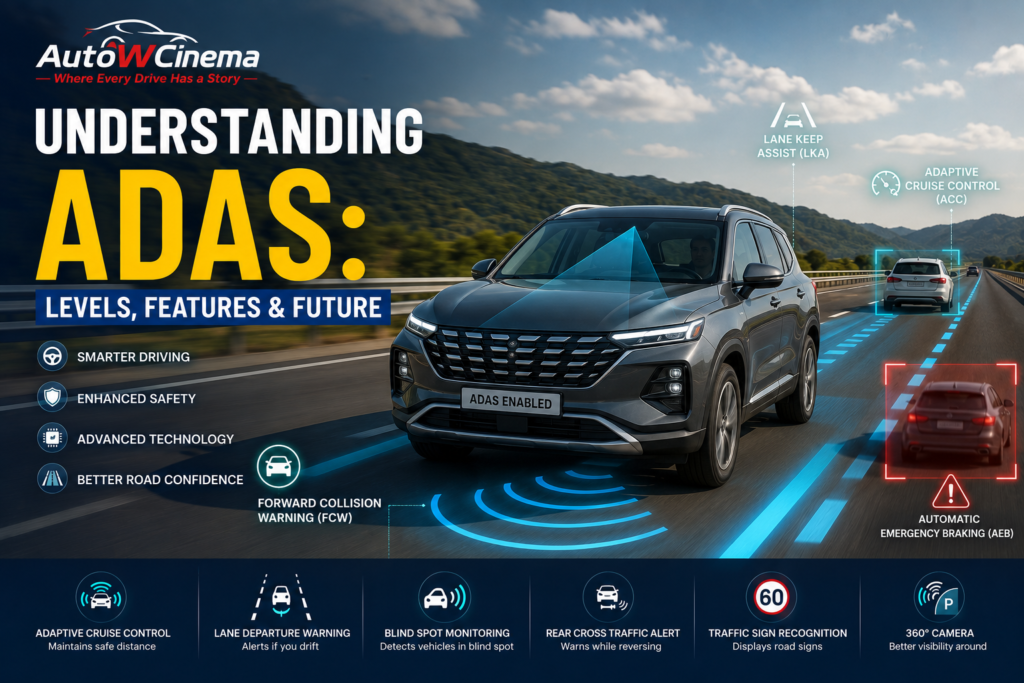
Adaptive Cruise Control (ACC)
Unlike traditional cruise control, Adaptive Cruise Control automatically adjusts the vehicle’s speed to maintain a safe distance from the vehicle ahead.
Benefits:
- Reduces driver fatigue
- Useful for highway driving
- Improves comfort
Automatic Emergency Braking (AEB)
AEB detects potential collisions.
If the driver doesn’t react in time, the system may automatically apply the brakes to reduce or avoid the impact, depending on the situation.
Lane Departure Warning (LDW)
This feature alerts the driver if the vehicle unintentionally drifts out of its lane without indicating.
Lane Keep Assist (LKA)
Lane Keep Assist can gently help steer the vehicle back toward the center of the lane when safe and appropriate.
Blind Spot Monitoring
Vehicles approaching from blind spots are detected.
Drivers receive visual or audible alerts before changing lanes.
Rear Cross Traffic Alert
Helpful while reversing.
The system warns if another vehicle, cyclist, or pedestrian is approaching from either side.
Forward Collision Warning
This feature alerts drivers when a collision risk is detected with the vehicle ahead.
Traffic Sign Recognition
Using front cameras, the vehicle identifies:
- Speed limits
- Stop signs
- Warning signs
- No-entry signs
Some vehicles display these signs on the instrument cluster or infotainment screen.
Driver Attention Monitoring
The system monitors driving patterns and may suggest taking a break if it detects signs of fatigue or reduced attention.
High Beam Assist
Automatically switches between high and low beams based on traffic conditions to improve nighttime visibility without dazzling other road users.
360-Degree Camera
Multiple cameras create a bird’s-eye view of the surroundings, making parking and maneuvering easier.
ADAS Levels Explained
The Society of Automotive Engineers (SAE) defines six levels of driving automation.
Level 0 – No Automation
The driver performs all driving tasks.
Only warning systems may be available.
Level 1 – Driver Assistance
The vehicle can assist with either steering or speed control.
The driver remains fully responsible.
Example:
- Basic adaptive cruise control
Level 2 – Partial Automation
This is the most common level available in India today.
The vehicle can assist with:
- Steering
- Acceleration
- Braking
However, the driver must remain attentive and ready to take control at all times.
Examples include many premium variants from:
- Mahindra
- Tata Motors
- Hyundai
- Kia
- Honda
- MG Motor
Level 3 – Conditional Automation
The vehicle can perform most driving tasks in certain conditions.
The driver must be ready to intervene when requested.
This level has limited availability globally.
Level 4 – High Automation
The vehicle can operate independently within specific environments or conditions.
Human intervention is rarely required within its operational limits.
Level 5 – Full Automation
No steering wheel or pedals are theoretically required.
The vehicle handles all driving tasks under all conditions.
Fully autonomous Level 5 vehicles are not yet commercially available.
Benefits of ADAS
Improved Road Safety
ADAS can help reduce the risk of accidents by assisting drivers in avoiding common hazards.
Reduced Driver Fatigue
Adaptive Cruise Control and Lane Keep Assist can make long highway drives less tiring.
Easier Parking
Features such as parking sensors and 360-degree cameras simplify parking in tight spaces.
Better Awareness
Blind Spot Monitoring and Rear Cross Traffic Alert improve awareness of surrounding traffic.
Enhanced Driving Confidence
ADAS can make driving more comfortable, especially for newer drivers, while still requiring their full attention.
Limitations of ADAS
Despite its advantages, ADAS has limitations.
Drivers should remember:
- Sensors may be affected by heavy rain, fog, or dirt.
- Poorly marked roads can reduce system effectiveness.
- Sharp curves may challenge some assistance systems.
- ADAS is an aid—not a replacement for safe driving.
Always keep your hands on the steering wheel when required and remain alert.
ADAS in India
ADAS is becoming increasingly common in the Indian market.
Many manufacturers now offer Level 2 ADAS in selected models.
Examples include:
- Mahindra XUV700
- Mahindra BE 6
- Mahindra XEV 9e
- MG Hector
- MG Gloster
- Honda City e:HEV
- Hyundai Tucson
- Hyundai IONIQ 5
- Hyundai Creta (selected variants)
- Kia Seltos (selected variants)
- Tata Harrier EV (where equipped)
- Tata Safari (selected variants)
Features may vary depending on the model year and variant, so always verify the equipment before purchasing.
Is ADAS Worth It?
For most buyers, especially those who frequently drive on highways, ADAS can be a valuable investment.
It offers:
- Additional safety
- Greater driving comfort
- Improved convenience
- Enhanced confidence
However, it should never encourage distracted or careless driving.
The Future of ADAS
The future of ADAS looks promising.
Upcoming advancements may include:
- More sophisticated AI-powered driver assistance
- Improved sensor accuracy
- Better integration with connected vehicles
- Enhanced pedestrian and cyclist detection
- Greater use of over-the-air software updates
- Progress toward higher levels of driving automation
As infrastructure and regulations evolve, ADAS technologies are expected to become more accessible across different vehicle segments in India.
Tips for Using ADAS Safely
- Read your vehicle’s owner’s manual.
- Understand what each feature can and cannot do.
- Keep cameras and sensors clean.
- Do not rely solely on automation.
- Stay attentive at all times.
- Practice using ADAS features in safe conditions before depending on them during regular driving.
Expert Opinion from AutoWCinema
ADAS represents one of the most significant safety innovations in modern automobiles. While no technology can eliminate every risk, these systems can assist drivers in avoiding many common driving situations when used correctly.
If you’re shopping for a new car in 2026, choosing a model equipped with well-calibrated ADAS features can be a worthwhile investment—particularly if you spend considerable time on highways or frequently travel with family.
Remember, the safest driver is still an attentive and responsible driver.
Frequently Asked Questions (FAQs)
What does ADAS stand for?
ADAS stands for Advanced Driver Assistance Systems, a group of technologies designed to improve safety and assist drivers.
Is ADAS fully self-driving?
No. Most ADAS-equipped vehicles available in India are Level 2 systems that require the driver to remain attentive and ready to take control.
Which ADAS level is available in India?
Level 2 ADAS is the most commonly available level in Indian passenger vehicles.
Is ADAS useful in city traffic?
Yes. Features such as Automatic Emergency Braking, Blind Spot Monitoring, and Parking Assistance can be helpful in urban driving conditions.
Does ADAS work in bad weather?
Performance may be reduced in heavy rain, dense fog, or when cameras and sensors are obstructed. Drivers should always remain alert.
Final Thoughts
Advanced Driver Assistance Systems are reshaping the future of driving by making vehicles smarter, safer, and more capable of assisting drivers in everyday situations. From adaptive cruise control to automatic emergency braking, these technologies are helping reduce risks and improve driving comfort.
As more manufacturers introduce ADAS across different price segments, buyers in India have greater access to advanced safety features than ever before. However, it’s important to understand that ADAS is designed to assist—not replace—the driver.
At AutoWCinema – Where Every Drive Has a Story, we believe informed drivers make safer choices. Whether you’re buying your first car or upgrading to a premium SUV, understanding ADAS will help you choose a vehicle that offers both confidence and peace of mind on every journey.
Suggestions to Read More:-
- Complete Guide to Buying a Car in India
- Complete Guide to Car Insurance in India
- How to Maintain Your Car
- Understanding Bharat NCAP Safety Ratings
- Best Family SUVs in India
- Best Cars with ADAS in India
- Petrol vs Diesel vs Hybrid vs Electric Cars
- SUV Buying Guide
thanks a lot…
Author- Nitesh Kumar